Search This Blog

Showing posts with label Labor. Show all posts

Thursday, January 8, 2026

AI can boost creativity

An original idea is not the same thing as a communicable original idea. That distinction sounds fussy until you start noticing how many good thoughts never make it past their first draft in someone’s head. Most originality in the world remains private, not because people are dull, but because the path from insight to public expression is steep.

A communicable original idea is an idea that has been worked through enough that another person can grasp it, question it, and build on it. It has examples. It has boundaries. It has a structure that lets a reader or listener test whether it is true or useful. That structure is not cosmetic. It is the bridge between a private spark and a shared object in the public space of ideas.

Two limits keep that bridge rare. The first is time. Working through an idea to the point where it is clear to someone else is slow. Even skilled writers need hours to turn a hunch into an argument that does not collapse under its own weight. The second limit is skill. Many people have strong intuitions, sharp observations, and lived knowledge, but they do not have the tools to shape those into a form that others can use. They might be brilliant in conversation and helpless on a blank page. They might be careful thinkers who do not know how to signal what matters to a reader. Their ideas are original, yet they remain trapped.

AI changes this equation in a plain way. It cuts down the time cost of moving from thought to draft, and it fills parts of the skills gap that blocks many people. That is the core claim, and it is boring in the best sense of the word. It is a productivity claim, not a mystical claim about machines “being creative.” The creative act stays human. The communicative labor can be shared.

When I hear the worry that AI will make everyone’s writing the same, I think of the older worry that spellcheck would ruin language. It did not. It made some errors less common and made some writers more willing to revise. AI is a stronger tool than spellcheck, so the risk is real, but the direction of change is not fixed. The result depends on what we ask it to do. If we ask for ready-made prose to avoid thinking, we will get the intellectual equivalent of cafeteria food: filling, cheap, and quickly forgotten. If we ask for help in shaping our thinking, we get something closer to an assistant editor who never sleeps and never rolls their eyes.

The simplest example is idea triage. Most of us have more ideas than we can develop. Some are promising, some are noise, and many are promising but vague. AI can help sort them. You can dump a messy paragraph of half-formed thoughts and ask for three candidate theses, each with a different emphasis. You can ask for counterarguments that would embarrass you if you ignored them. You can ask for the hidden assumptions in your claim. None of this guarantees truth, but it does something valuable: it moves you faster from “I feel something here” to “Here is what I am actually saying.”

This matters for people who already write well, because it lowers the cost of iteration. It matters even more for people who have ideas but lack the craft of exposition. We often romanticize that craft, as if difficulty is proof of virtue. In practice, the craft functions like a gate. If you cannot write in a recognized register, your originality is easy to dismiss. If you do not know how to structure an argument, you might never offer it. AI can act as a translator across registers. It can turn a spoken explanation into a readable paragraph. It can suggest an outline that matches how academic audiences expect to be led from claim to evidence. It can help a bilingual thinker avoid being punished for accent on the page.

The anxieties around AI often confuse originality with output. People see more text and assume less thought. That can be true, but it is not necessary. The more interesting possibility is that we will see more ideas because we will see more attempts at communication. Most attempts will be mediocre. That is not a crisis. The public space of ideas has always been full of mediocre attempts. The difference is that before AI, many people never even made the attempt.

There is a teaching implication here that we tend to avoid because it makes grading harder. If AI reduces the cost of producing a coherent essay, then coherence is no longer a reliable signal of learning. That does not mean students should be banned from AI. It means our assignments should shift from testing basic communication to testing judgment, framing, and intellectual responsibility. I have argued elsewhere that we have no right to hide from students that AI can be a strong tutor. The same logic applies to writing support. If the tool exists, students will use it, and some will use it well. Our job is to make “using it well” visible and assessable.

One way is to grade the thinking trail, not only the final product. Ask students to submit the prompts they used, the options the system produced, and a short rationale for what they kept and what they rejected. This turns AI from a shortcut into a mirror. Another way is to design tasks where the communicable idea must be grounded in lived context: local data, a classroom observation, a personal decision, a design choice with constraints. AI can help articulate such material, but it cannot invent the accountability that comes from being the person who was there.

There is also a relational dimension that matters to me as an educator. Communication is not only transmission. It is an invitation. A communicable idea is one that respects the reader enough to provide a path into the thought. AI can help with that respect by making revision less punishing. Many people stop revising because revision feels like failure. AI reframes revision as a normal dialogue. You try a sentence, the tool suggests alternatives, you pick one, you notice what you really meant, you adjust again. That is not cheating. That is apprenticeship, with a strange new partner.

Of course, AI can also flood the world with plausible nonsense. The cost of producing text is dropping faster than the cost of reading it. That creates a new bottleneck: attention and trust. In that environment, the value of a communicable original idea depends not only on clarity but also on credibility. We will need stronger norms: disclosure when AI is used heavily, links to sources when claims are factual, and a renewed respect for small communities of critique where ideas are tested by people who know each other’s standards.

If we take that seriously, AI does not have to be the enemy of creativity. It can be the enemy of silence. The great loss in intellectual life is not bad writing. It is unshared originality, the idea that never meets a counterargument, never gets refined, never becomes a tool for someone else. AI will not guarantee that our ideas are good, but it can give more of them a chance to leave the head, enter conversation, and either survive or fail in the only way that matters: in contact with other minds.


Tuesday, August 19, 2025

Why Agentic AI Is Not What They Say It Is

There is a lot of hype around agentic AI, systems that can take a general instruction, break it into steps, and carry it through without help. The appeal is obvious: less micromanagement, more automation. But in practice, it rarely delivers.

These systems operate unsupervised. If they make a small mistake early on, they carry it forward, step by step, without noticing. By the time the result surfaces, the damage is already baked in. It looks finished but is not useful.

Humans handle complexity differently. We correct course as we go. We spot inconsistencies, hesitate when something feels off, we correct. That instinctive supervision that is often invisible, is where most of the value lies. Not in brute output, but in the few moves that shape it. 

The irony is that the more reliable and repeatable a task is, the less sense it makes to use AI. Traditional programming is better suited to predictable workflows. It is deterministic, transparent, and does not hallucinate. So if the steps are that well defined, why introduce a probabilistic system at all?

Where AI shines is in its flexibility, its ability to assist in murky, open-ended problems. But those are exactly the problems where full AI autonomy breaks down. The messier the task, the more essential human supervision becomes.

There is also cost. Agentic AI often burns through vast compute resources chasing the slightly misunderstood task. And once it is done, a human still has to step in and rerun it? burning through even more resources.

Yes, AI makes humans vastly more productive. But the idea that AI agents will soon replace humans overseeing AI feels wrong. At least I have not seen anything even remotely capable of doing so. Human supervision is not a weakness to be engineered away. It is where the human-machine blended intelligence actually happens.


Sunday, February 9, 2025

AI and Labor: A Smarter Path Forward

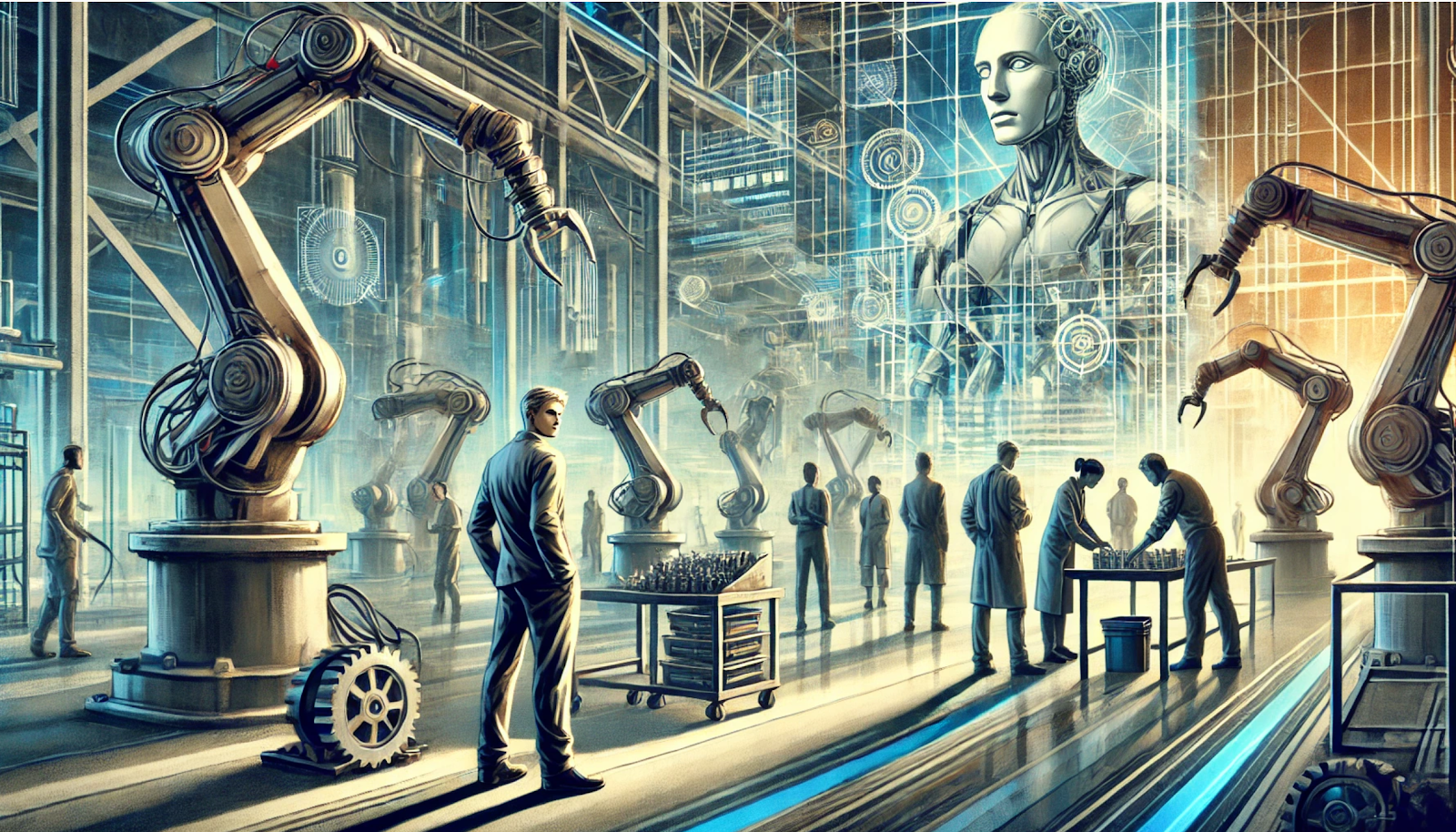
Trade unions face a defining moment. Artificial intelligence presents genuine concerns about job displacement, yet the response need not mirror historical patterns of resistance to technological change. The Luddite movement of the 1810s serves as a cautionary tale - their destruction of mechanized looms neither preserved jobs nor improved workers' conditions. All technology affects labor; that it what technology is, work assistance. 

The automation paradox offers a more nuanced perspective. While machines replace specific tasks, they generate new forms of work. The introduction of automated teller machines in banking led to more bank branches and tellers performing complex customer service roles. This pattern repeats across industries - automation reduces costs, expands services, and creates different job categories.

Labor leaders would serve their members better by negotiating robust transition arrangements. Key demands should include employer-funded retraining programs, preferential access to new positions, and compensation packages that recognize acquired skills. The focus must shift from preventing change to shaping its implementation.

The pace of AI integration varies significantly by sector. Manufacturing and data processing may see rapid adoption, but industries built on human relationships - education, healthcare, social work - will incorporate AI gradually as assistive technology. Complex organizations require extensive testing and workflow redesign before meaningful automation becomes feasible.

Economic history demonstrates that reduced production costs expand economic activity. When basic tasks become automated, human attention shifts to more sophisticated problems. The telephone eliminated telegraph operators but created vast new communication industries. Similarly, AI will likely automate routine cognitive work while opening possibilities in areas we have not yet imagined.

Unions retain significant leverage during this transition. Organizations need experienced workers to implement new technologies effectively. This position allows labor to negotiate favorable terms - extended notice periods, substantial retraining budgets, wage protection during transition, and clear paths to higher-skilled roles.

The key lies in recognizing AI as a tool for augmentation rather than pure replacement. A machine learning system may process medical images faster than radiologists, but interpreting results in complex cases still requires human judgment. Similar patterns will emerge across professions - AI handling routine tasks while humans focus on nuanced decision-making and interpersonal elements.

Rather than resist change, unions should position themselves as partners in managing transition. This approach preserves their relevance and better serves member interests. The alternative - attempting to prevent AI adoption - risks marginalization as companies seek ways around opposition or relocate to more amenable jurisdictions.

The challenge for labor leadership is to shift from defensive postures to proactive engagement. This means developing expertise in emerging technologies, identifying opportunities for worker advancement, and ensuring transition arrangements protect vulnerable members while facilitating adaptation to changing workplace demands.


Tuesday, February 4, 2025

Augmented Problem Finding: The Next Frontier in AI Literacy

In my recent blog on task decomposition as a key AI skill, I highlighted how breaking down complex problems enables effective human-AI collaboration. Yet before we can decompose a task, we must identify which problems are worth pursuing - a skill that takes on new dimensions in the age of AI.

This ability to recognize solvable problems expands dramatically with AI tools at our disposal. Tasks once considered too time-consuming or complex suddenly become manageable. The cognitive offloading that AI enables does not just help us solve existing problems - it fundamentally reshapes our understanding of what constitutes a tractable challenge.

Consider how VisiCalc transformed financial planning in the early 1980s. Initially seen as a mere automation tool for accountants, it revolutionized business planning by enabling instant scenario analysis. Tasks that would have consumed days of manual recalculation became instantaneous, allowing professionals to explore multiple strategic options and ask "what if" questions they would not have contemplated before. Similarly, AI prompts us to reconsider which intellectual tasks we should undertake. Writing a comprehensive literature review might have once consumed months; with AI assistance, scholars can now contemplate more ambitious syntheses of knowledge.

This expanded problem space creates its own paradox. As more tasks become technically feasible, the challenge shifts to identifying which ones merit attention. The skill resembles what cognitive psychologists call "problem finding," but with an important twist. Traditional problem finding focuses on identifying gaps or needs. Augmented problem finding requires understanding both human and AI capabilities to recognize opportunities in this enlarged cognitive landscape.

The distinction becomes clear in professional settings. Experienced AI users develop an intuitive sense of which tasks to delegate and which to tackle themselves. They recognize when a seemingly straightforward request actually requires careful human oversight, or when an apparently complex task might yield to well-structured AI assistance. This judgment develops through experience but could be taught more systematically.

The implications extend beyond individual productivity. Organizations must now cultivate this capacity across their workforce. The competitive advantage increasingly lies not in having access to AI tools - these are becoming ubiquitous - but in identifying novel applications for them. This explains why some organizations extract more value from AI than others, despite using similar technologies.

Teaching augmented problem finding requires a different approach from traditional problem-solving instruction. Students need exposure to varied scenarios where AI capabilities interact with human judgment. They must learn to recognize patterns in successful AI applications while developing realistic expectations about AI limitations. Most importantly, they need practice in identifying opportunities that emerge from combining human and machine capabilities in novel ways.

The skill also has ethical dimensions. Not every task that can be automated should be. Augmented problem finding includes judging when human involvement adds necessary value, even at the cost of efficiency. It requires balancing the technical feasibility of AI solutions against broader organizational and societal impacts.

As AI capabilities evolve, this skill will become increasingly crucial. The future belongs not to those who can best use AI tools, but to those who can best identify opportunities for their application. This suggests a shift in how we think about AI literacy - from focusing on technical proficiency to developing sophisticated judgment about when and how to engage AI capabilities.

The automation paradox that Lisanne Bainbridge identified in her 1983 analysis of industrial systems points to an interesting future. As we become more adept at augmented problem finding, we discover new challenges that merit attention. This creates a virtuous cycle of innovation, where each advance in AI capability opens new frontiers for human creativity and judgment.

Perhaps most intriguingly, this skill might represent a distinctly human advantage in the age of AI. While machines excel at solving well-defined problems, the ability to identify worthy challenges remains a uniquely human capability. By developing our capacity for augmented problem finding, we ensure a meaningful role for human judgment in an increasingly automated world.


Monday, January 13, 2025

The Myth of AI Replacing Teachers: Why Human Connection Matters More Than Ever

Last week, a colleague asked me what I thought about AI replacing teachers. The question made me smile - not because it was silly, but because it revealed how deeply we misunderstand both artificial intelligence and teaching. As someone who has written much on the pedagogy of relation and now serves as chief AI officer, I see a different story unfolding.

The fear of AI replacing teachers rests on a peculiar assumption: that teaching is primarily about delivering information and grading papers. It is as if we imagine teachers as particularly inefficient computers, ready to be upgraded to faster models. This view would be amusing if it weren't so prevalent among teachers (and their labor unions) and tech enthusiasts alike.

Teaching, at its heart, is not about information transfer - it is about relationship building. Research in relational pedagogies has shown time and again that learning happens through and because of human connections. Think about how children learn their first language: not through formal instruction, but through countless small interactions, emotional connections, and social bonds. The same principle extends throughout the entire education.

When I first encountered ChatGPT, I was struck not by its ability to replace teachers, but by its potential to give them back what they need most: time for human connection. AI can handle the mundane tasks that currently consume teachers' energy - generating basic content, providing routine feedback, creating initial drafts of lesson plans. But it cannot replicate the raised eyebrow that tells a student their argument needs work, or the encouraging nod that builds confidence in a hesitant learner.

Yet many educators remain skeptical of AI, and perhaps they should be. Any tool powerful enough to help is also powerful enough to harm if misused. But the real risk isn't that AI will replace teachers - it is that we'll waste its potential by focusing on the wrong things. Instead of using AI to automate educational assembly lines, we could use it to create more space for real human connection in learning.

I have seen glimpses of this future in my own classroom. When AI can answer routine questions about my syllabus, and lots of basic questions about content of the course, I can spend more time in meaningful discussions with students. When it helps generate initial content, I can focus on crafting experiences that challenge and engage. The technology becomes invisible, while human relationships move to the foreground.

The coming years will transform education, but not in the way many fear. The teachers who thrive won't be those who resist AI, nor those who embrace it uncritically. They will be the ones who understand that technology works best when it strengthens, rather than replaces, human relationships.


Saturday, October 19, 2024

Where is the work? AI and Creativity

For ages, we have blurred the lines between ideation and execution, treating them as inseparable parts of creativity. Craftsmanship was tightly bound to originality. Think of Michelangelo working on the Sistine Chapel, a project that spanned nearly a decade. Where does his genius truly lie? In envisioning those profound images, or in the labor of painting them? What, exactly, is the essence of the work?

The rise of AI forces us to untangle these ideas and reconsider what it means to produce "human" work. Take a recent story I heard from from the audience of one of my talks: a person described how he fed an AI every detail about a retiring colleague, and the AI generated a speech so moving that it brought the retiree to tears. But the retiree, upon learning the speech's origin, was dumbfounded.

What is interesting is not the retiree’s reaction, but the storyteller's own oversight. He failed to see his own critical role in the process. By gathering the details, curating moments that best captured the retiree’s essence, he performed the most human part of the creative act. He mistook the act of turning those ideas into words as the creative work, but that is not the case.

AI, ironically, is pushing us to be more human, not more like machines. It is forcing us to recognize that our true contribution lies in the ability to think, to create, and to feel. As AI takes over the mechanical aspects of tasks we once considered integral to creativity—whether that is writing, painting, or coding—we are left with the more uniquely human roles: original thinking and emotional depth.

This shift reshapes our understanding of creativity and work. It shows that human value does not lie in production—the technical aspect of turning an idea into a product—but in the deeper conceptual and emotional layers that AI still cannot reach.

As we move forward, we are compelled to rethink productivity itself. The future will not belong to those who can outdo AI in execution, but to those who can combine AI’s strengths with our unique capacities for innovation, empathy, and insight.

The challenge we face is not to resist AI, but to fully embrace our humanity—to cultivate the traits that machines cannot replicate. With AI taking over the drudgery, we are freed to focus on higher-order thinking and those creative leaps that define human ingenuity.

Ironically, the more we develop artificial intelligence, the more we learn about what human intelligence really is. And in that discovery lies our future—a future where AI does not replace creativity, but elevates it to new possibilities.


Thursday, September 12, 2024

The Stealth AI Adoption

In modern workplaces, a quiet trend is taking hold: employees are secretly adopting artificial intelligence tools to enhance their work. Whether it is writing, designing, coding, or creating content, many are leveraging AI without informing their bosses. This “stealth AI adoption” is likely more widespread than managers realize.

Consider Alex, a software developer at a bustling tech firm. To streamline his coding process, Alex uses an AI assistant that can generate snippets of code in seconds. This tool not only saves him hours each week but also allows him to tackle more complex projects. However, Alex keeps this AI helper under wraps. Why? He has two choices: use the extra time for personal activities or take on additional work to appear more productive than his peers. There is no actual incentive to admit the use of AI. In some shops, cybersecurity people will come after you, if you confess. 

This hidden use of AI offers clear benefits for employees. Saving a few hours each week is tempting, whether for personal pursuits or to discreetly boost one’s workload. As a result, many organizations might be underestimating how extensively AI is being integrated into daily tasks.

Productivity can be measured in two ways: doing the same work with fewer people or doing more with the same number. The latter is a healthier, more sustainable approach. To achieve true success, organizations should aim to do more with their existing workforce rather than cutting staff. However, the stealth adoption of AI complicates this goal.

When employees use AI tools without disclosure, organizations miss out on opportunities to harness these technologies strategically. Without knowing how AI is being utilized, companies can not provide proper training or integrate AI into their workflows effectively. This fragmented approach can lead to missed efficiency gains and a lack of cohesive progress.

To foster a productive and innovative environment, companies need to build trust with their employees. Here is how:

  1. Reassure Employees: Let your team know that adopting AI will not lead to layoffs. Emphasize that AI is a tool to help them do their jobs better, not a replacement for their roles. In unionized environments, a conversation with labor leaders would be wise. 

  2. Create Incentives for Disclosure: Encourage employees to share the AI tools they are using by offering rewards or recognition. This transparency can help management understand how AI is being integrated and identify best practices.

  3. Do More with the Same People: Focus on expanding the scope of work and fostering innovation rather than cutting positions. This approach not only boosts morale but also drives the organization forward.

By building trust and creating a supportive environment, organizations can turn stealth AI adoption into a strategic advantage. Employees will feel comfortable sharing their AI discoveries, allowing organizations to implement these tools effectively and sustainably.

As we move further into the AI-driven era, organizations must address this hidden trend. Encouraging transparency about AI tools and developing clear strategies for their use can ensure that productivity gains are real and sustainable. Until then, the silent spread of AI will keep reshaping workplaces, one undisclosed tool at a time. 


Friday, August 23, 2024

Filling Voids, Not Replacing Human Experts

The debate over artificial intelligence replacing human experts often centers on a binary question: Can AI do a better job than a human? This framing is understandable but overly simplistic. The reality is that in many contexts, the competition is not between AI and people—it is between AI and nothing at all. When viewed through this lens, the value of AI becomes clearer. It is not about pitting machines against human expertise; it is about addressing the voids left by a lack of available service.

Consider healthcare, particularly in underserved areas. It is a truism that a qualified doctor’s advice is better than anything an AI could provide. But what if you live in a rural village where the nearest doctor is hundreds of miles away? Or in a developing country where medical professionals are stretched thin? Suddenly, the prospect of AI-driven medical advice does not seem like a compromise; it feels like a lifeline. While AI lacks the nuanced judgment of an experienced physician, it can provide basic diagnostics, suggest treatments, or alert patients to symptoms that warrant urgent attention. In such scenarios, AI does not replace a doctor—it replaces the silence of inaccessibility with something, however imperfect.

Another case in point is mental health counseling. In many parts of the world, even in affluent countries, mental health services are woefully inadequate. Students at universities often face wait times ranging from weeks to months just to speak with a counselor. During that limbo, the option to interact with an AI, even one with obvious limitations, can be a critical stopgap. It is not about AI outperforming a trained therapist but offering a form of support when no other is available. It can provide coping strategies, lend a sympathetic ear, or guide someone to emergency services. Here, AI does not replace therapy; it provides something valuable in the absence of timely human support.

Education offers another case for AI’s gap-filling potential. Tutoring is an essential resource, but access to quality tutors is often limited, mainly because it is expensive. Universities might offer tutoring services, but they are frequently understaffed or employ peer tutors. Office hours with professors or teaching assistants can be similarly constrained. AI can step into this void. Chatting with an AI about a difficult concept or problem set might not equal the depth of understanding gained from a one-on-one session with a human tutor, but it is unquestionably better than struggling alone. AI does not compete with tutors; it extends their reach into spaces they cannot physically or temporally cover.

The same logic applies to a range of other fields. Legal advice, financial planning, career coaching—all are areas where AI has the potential to add significant value, not by outstripping human expertise but by offering something in environments where professional advice is out of reach. Imagine a low-income individual navigating legal complexities without the means to hire an attorney. An AI could provide at least basic guidance, clarify legal jargon, and suggest possible actions. All of it must be done with proper disclaimers. It is not a substitute for legal representation, but it is a world better than the alternative: no help at all.

In embracing this non-competing stance, we shift the narrative. The role of AI is not to replace human experts but to step in where human services are scarce or nonexistent. The true potential of AI lies in its ability to democratize access to essential services that many people currently go without. When AI is viewed as a bridge rather than a rival, its utility becomes much more evident. AI does not have to be better than a person to be valuable; it just should be better than the void it fills.


Friday, August 9, 2024

Authorship, Automation, and Answerability

In the ongoing debate about the ethical use of AI, two main concerns stand out—one superficial and one profound. The first concern, often highlighted, is about the authenticity of authorship, with fears that AI-generated content might mislead us about who the true author is. However, this worry is largely misguided. It stems from a historically limited, Western-centric notion of authorship that blurs the line between the origin of ideas and the craft of their representation.

Take the legacy of Steve Jobs. He wasn’t celebrated for personally assembling each iPhone, but for his vision and design that brought the device to life. In our industrial world, the act of making things is not inherently authorial—designing them is. Why should it be any different with text, code, or images? If I designed this text, and used advanced tools to produce it, why am I not still the author? The shock many feel towards AI’s ability to generate content is akin to the upheaval experienced by 19th-century bootmakers during the Industrial Revolution. Automation has simply extended its reach into the realms of writing, coding, and art. The craftsmanship is replaced by automation, but the core principle remains: take pride in the ideas, not in the mechanics of their production. There is no inherent authorship in the latter.

But here’s where Mikhail Bakhtin’s notion of answerability helps our understanding of the true ethical stakes. While responsibility is often about fulfilling obligations or being held accountable after the fact, answerability is about our ongoing, active engagement with the world and the people in it. It is not just about who gets credit for the content; it is about recognizing that every action, every word, and every piece of AI-generated content occurs within a web of relationships. We are answerable to others because our creations—whether authored by human hands or machine algorithms—affect them.

The real concern, then, lies in the issue of answerability. AI-generated content often appears polished, convincing, and ready for immediate consumption. This creates a dangerous temptation to release such content into the world without thorough scrutiny. Here is where the ethical stakes rise significantly. AI may produce work that looks and sounds credible, but this does not guarantee that it is unbiased, meaningful, or truthful. It maybe garbage polluting the infosphere at best, or an outward harmful fake at worst. The ease of content creation does not absolve us of the responsibility to ensure its quality and integrity, and more importantly, it doesn’t free us from the answerability we have to the world around us.

This is the message we need to instill in our students, professionals, and anyone working with AI: you are still accountable and answerable for what you produce, even if a machine does the heavy lifting. Releasing AI-generated content without critical evaluation is akin to conjuring a spell without understanding its consequences. Like a magician wielding powerful but unpredictable magic, or a novice driver behind the wheel of a truck instead of a bicycle, the stakes have been raised. The tools at our disposal are more potent than ever, and with that power comes a heightened level of answerability.

In essence, the ethical debate surrounding AI shuold not be about the authorship of the craft but shuold be about the integrity and impact of the output. The real challenge is ensuring that what we create with these advanced tools is not only innovative but also responsible and answerable. As we continue to integrate AI into more aspects of our lives, we must focus less on who—or what—authored the content and more on the ethical implications of releasing it into the world. This is where the true ethical discourse lies, and it is here that our attention should be firmly fixed.


Tuesday, April 23, 2024

AI revolution minus massive unemployment

The conversation on AI often revolves around efficiency and cost reduction, typically translating into fewer jobs. However, a pivotal shift in perspective—from cutting workforce to enhancing and expanding workforce capabilities—can redefine the role of AI in the corporate world. This approach not only preserves jobs but also adds significant value to customer experiences and broadens the spectrum of services and products a company can offer. 

The traditional method of dealing with technological disruption—laying off workers and hiring new ones with the necessary skills—is not only a waste of human capital but also disregards the cultural knowledge embedded within an organization's existing workforce. Retraining keeps people within the organization, allowing them to shift roles while retaining and applying their invaluable understanding of the company's ethos and operations in new ways.

The first step in a proactive workforce transformation strategy is to map out the anticipated skills and roles that will be in demand. This is not just about foreseeing the obsolescence of certain skills but identifying emerging opportunities where AI can augment human capabilities. For instance, with the rise of AI-driven analytics, there is a growing need for professionals who can interpret and leverage these insights into strategic decisions, enhancing business intelligence far beyond current levels.

Once future needs are mapped, the next step is to develop a compelling incentive structure for retraining. Traditional models of employee development often rely on mandatory training sessions that might not align with personal or immediate business goals. Instead, companies should offer tailored learning pathways that align with career progression and personal growth, supported by incentives such as bonuses, career advancement opportunities, and recognition programs. This approach not only motivates employees to embrace retraining but also aligns their development with the strategic goals of the organization.

With AI's capacity to handle repetitive and mundane tasks, employees can redirect their efforts towards more complex, creative, and meaningful work. This shift enables businesses to expand their service offerings or enhance their product features, adding significant value to what customers receive. For example, financial advisors, freed from the tedium of data analysis by AI tools, can focus on crafting bespoke investment strategies that cater to the intricate preferences and needs of their clients. Similarly, customer service representatives can use insights generated by AI to provide personalized service experiences, thereby increasing customer satisfaction and loyalty.

AI not only optimizes existing processes but also opens new avenues for innovation. For instance, in the healthcare sector, AI can manage diagnostic data with high efficiency, which allows healthcare providers to extend their services into preventive health management and personalized medicine, areas that were previously limited by resource constraints. In the retail sector, AI-enhanced data analysis can lead to the creation of highly personalized shopping experiences, with recommendations and services tailored to the individual preferences of each customer, transforming standard shopping into curated personal shopping experiences.

For successful implementation, organizations must foster a culture that views AI as a tool for empowerment rather than a threat to employment. Leadership should communicate clearly about the ways AI will be used to enhance job roles and the benefits it will bring to both employees and the company. Regular feedback loops should be established to adjust training programs based on both employee input and evolving industry demands, ensuring that retraining remains relevant and aligned with market realities.

By focusing on retraining the workforce to harness AI effectively, businesses can transform potential disruptions into opportunities for growth and innovation. This approach not only preserves jobs but also enhances them, adding unprecedented value to the company and its customers, and paving the way for a future where human ingenuity and artificial intelligence work hand in hand to achieve more than was ever possible before.

If You Cannot Solve AI in Your Classroom, That Is Not Proof It Cannot Be Solved

When the first big AI tools became public, the first thing I did was join a handful of Facebook groups about AI in education. I wanted a qui...